



 Home / News & Events /
 -
Share
-

-

-

-

Updated 2 weeks ago
Cash Register Roll Quality Testing: 7 Technical Parameters Buyers Should Check
admin

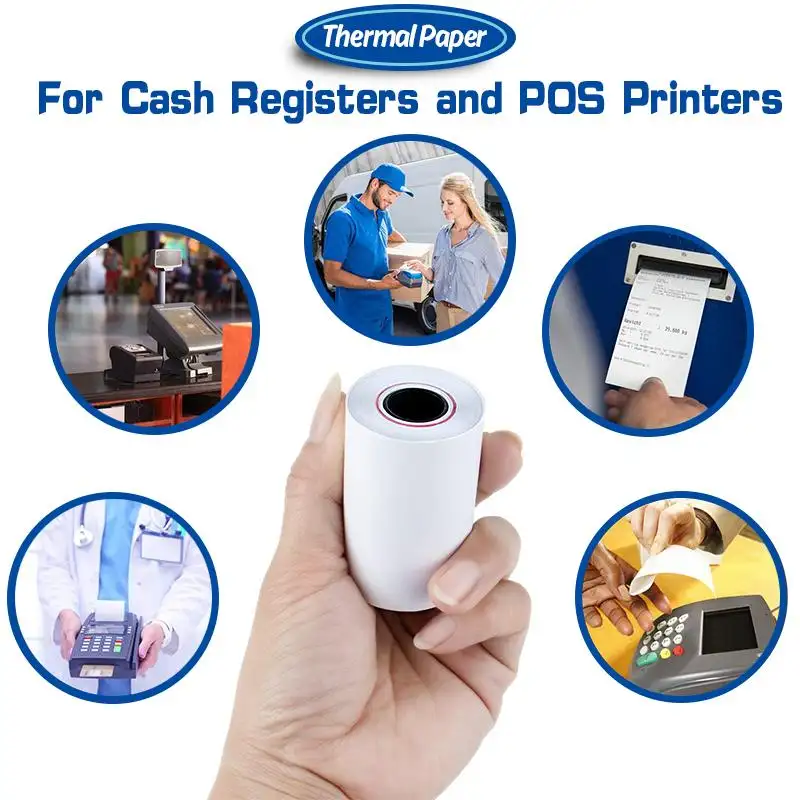
A Cash Register Roll should not be judged only by paper whiteness, roll diameter, or unit price. For distributors, retailers, POS suppliers, and importers, the more useful question is whether the roll will deliver consistent length, stable thermal response, clean feeding, and readable receipts across repeated production batches.
At Jinbao Brother, we evaluate Cash Register Roll quality from the paper itself through coating, slitting, rewinding, and finished-roll inspection. The following seven parameters are the areas buyers should examine when approving a sample or comparing suppliers.
1. Dimensional Accuracy: Width, OD, and Core ID
Printer compatibility starts with physical dimensions.
A Cash Register Roll specification normally needs to define:
•Roll width — the paper width entering the printer
•OD (outer diameter) — affects how much roll space the printer requires
•Core ID (inner diameter) — must suit the printer mechanism
•Roll alignment — the finished roll should be wound centrally and evenly
A roll sold as "80 mm" does not automatically tell the buyer its diameter, core size, or usable length.
For incoming inspection, measure several rolls from the same carton with a caliper. The key issue is not only whether one roll meets specification, but whether dimensions remain consistent across the batch.
2. GSM, Caliper, and Actual Roll Length
One of the most common purchasing mistakes is assuming that two Cash Register Roll products with the same width and OD contain the same amount of paper.
Let's take a look at the variables that impact the efficiency of Cash Register rolls.
| Variable | Consequence | Importance |
| GSM (Gramma per Square Meter) | Type and construction of material | Important for final product. |
| Caliper | Thickness of paper | Determines how much paper fits onto a given roll diameter. |
| Core Size | Size of the paper roll | Effects paper capacity |
| Actual Length | Length of paper | Reduces paper capacity |
Thin paper is able to contain more actual length than thick paper. Smaller cores are able to contain longer actual length than larger cores.
Because of this, the cost per usable meter should be taken into account when sourcing Cash Register rolls. The cost per finished roll does not take this into account.
3. Thermal Sensitivity
How quickly a paper is able to develop an image is determined by the efficiency of the heat-sensitive coating.
In practice, buyers should consider both:
Static Sensitivity
How readily the coating reacts to heat.
Dynamic Sensitivity
How effectively the paper develops an image during actual high-speed printing.
A Cash Register Roll with unsuitable sensitivity may print adequately at low speed but produce lighter characters when the POS printer runs quickly.
A practical comparison should use:
•The same thermal printer
•The same printhead setting
•The same receipt file
•The same printing speed
Compare text, fine lines, barcodes, and QR codes rather than judging only a large black area.
4. Print Density and Edge Definition
Dark printing does not guarantee a print has the required quality.
Optical Density and Contrast are measures of image quality, and Edge Definition is a measure of how sharp an image is.
These become crucial when dealing with:
•Barcodes
•QR codes
•Riral Acts (Identification Numbers)
•Small Fonts
•Coupons and Loyalty Cards
The best way to verify barcodes, is to print barcode samples and check if samples are scanned correctly. Dark barcodes don't necessarily mean they will be scanned correctly.
5. Coating Uniformity, Smoothness, and Paper Dust
Thermal paper is coated with a layer of color. It is this color coating which holds the image. It is important for the coating to be smooth, and uniform, so that the image is developed equally.
At Jinbao Brother, paper samples are assessed to determine if coating is uniform and smooth.
When evaluating a receipt roll, look for:
•Print samples which are consistent and even.
•Even and uniform print density.
•A low amount of paper dust.
•No defects or irregularities on the slit edge.
•Smooth paper as it passes through the printer.
Accumulation of paper dust and irregular edges of the paper can contribute to print misalignment, and increase the need for printhead cleaning.
6. Slitting and Winding Quality
Many Cash Register Roll problems are converting problems rather than base-paper problems.
During production, jumbo thermal paper is slit to the required width and rewound into finished rolls. Poor control at this stage can produce:
•Rough or feathered edges
•Loose winding
•Excessive roll hardness
•Telescoping
•Uneven roll faces
•Width variation
•Irregular feeding resistance
Winding tension should therefore be controlled, not simply made "as tight as possible."
Jinbao Brother's published QC process includes checks before, during, and after cutting for width, thickness, diameter, surface condition, edge smoothness, length precision, alignment, and thermal performance.
7. Image Durability and Storage Stability
A thermal image continues to interact with its environment after printing.
Image stability can be influenced by:
•Heat
•UV or strong light
•Humidity
•Friction
•Oils
•Plasticizers
•Chemical contact
The correct Cash Register Roll specification therefore depends on the intended application.
A short-life restaurant receipt and a transaction document requiring longer storage do not necessarily need the same thermal-paper construction.
Instead of asking only, "How long will the receipt last?", buyers should specify required image life and expected storage conditions.
A Practical Cash Register Roll Sample Test
Six Key Steps for Evaluating a Bulk Order
1. Measure
Check measurements like width, OD, ID, and dimension. Check for consistency throughout the entire length of the roll.
2. Print
Have the roll printed at normal speed in the target POS printer.
3. Scan
Check bar codes and QR codes. Don't assess codes based on readability.
4. Inspect
Check the roll for dust, winding issues, slit edges, and the quality of the roll face coating.
5. Compare
A single roll should not represent the entire batch. Each roll of the batch should be tested.
6. Verify
Check the actual roll length and the roll packaging. If required, check the consignment contains the correct declared documentation concerning the chemicals.
Export customers should also make sure requirements such as BPA-free and Phenol-free are met. In general, it's best to assume there are different requirements for each market.
The Most Important QC Question: Is the Batch Consistent?
The most useful spec for cash register rolls is consistent reproduction. For a customer it's best for reproduction to be consistent from run to run as compared to one run having exceptional performance. Changes in the formulation of the roll can affect its performance.
That is why sample approval should establish measurable reference points for future shipments.
Final Thoughts
A professional Cash Register Roll evaluation should connect seven areas: dimensions, GSM and caliper, actual length, thermal sensitivity, print density, coating quality, converting accuracy, and image durability.
At Jinbao Brother, thermal-paper coating, jumbo-roll slitting, and finished-product packaging are handled within an integrated manufacturing process, allowing quality checks to follow the material from coating through finished roll production.
If you are developing a new Cash Register Roll specification or comparing samples for wholesale, retail, POS, or OEM applications, you can visit HERE to review Jinbao Brother's thermal paper capabilities and discuss the dimensions, paper properties, printing performance, and testing requirements relevant to your application.
FAQs
Q1. What Cash Register Roll sizes does Jinbao Brother offer?
Jinbao Brother supplies common Cash Register Roll widths such as 57 mm and 80 mm, with different roll diameters and core sizes. Custom dimensions are also available for specific POS applications.
Q2. Can Jinbao Brother customize Cash Register Roll specifications?
Yes. Buyers can customize roll width, diameter, core size, roll length, coating options, packaging, and other specifications according to printer and market requirements.
Q3. Does Jinbao Brother provide OEM Cash Register Roll services?
Yes. Jinbao Brother supports OEM and ODM production, including custom sizes, private-label packaging, logo printing, and other branding requirements.
Q4. How does Jinbao Brother control Cash Register Roll quality?
Quality control covers parameters such as dimensions, paper thickness, roll diameter, thermal performance, surface condition, edge quality, roll alignment, and finished-roll consistency.
Q5. Are Jinbao Brother Cash Register Rolls suitable for POS printers?
Jinbao Brother produces thermal Cash Register Roll products for POS machines, cash registers, receipt printers, and similar thermal printing equipment. Correct width, diameter, and core size should always be matched to the printer model.
We'll Get Back Within 24 Hours
Related Articles
Cash Register Roll Quality Testing: 7 Technical Parameters Buyers Should Check
2026-09-30

Custom Carbon Copy Paper Technology | Jinbao Brother
2026-09-30
How Long Do A4 Thermal Paper Rolls Last? Image Durability and Storage Explained
2026-09-29
Eco-Friendly A4 Thermal Printing Paper: Sustainability Trends and Recyclability
2026-09-29
